Category

Marketing & Communication

How do you make a good employer brand video?

By Marketing & Communication

To attract talent faster and more effectively, it is crucial that potential candidates become familiar with your company as an employer. Common questions such as “What kind of company culture can I expect?”, “What is it like to work for you?” and “What is the company’s vision?” are essential for job applicants. With an employer brand video, you answer these questions early on and position your brand as an attractive employer at the same time. ✨

What is an employer brand video?

An employer brand video is a video that companies use to inform and convince potential employees of their attractiveness as an employer. It serves as an effective tool to communicate the company culture, core values and workplace environment in a positive and engaging way. The video can include various elements, such as interviews with current employees sharing their experiences, images of the work environment and relevant work activities, and a focus on the company’s mission and values. The ultimate goal is to present an authentic and positive image of the organization, attracting potential candidates and giving the company a competitive advantage in the talent market. The effective use of an employer brand video helps strengthen employer reputation and attract qualified professionals who can identify with the company culture.

What should you pay attention to when creating an employer brand video?

To achieve success with your employer brand video, these steps are essential:

1. Determine your target audience

Identify the specific audience you want to target the video to. Is it aimed at recent graduates, experienced professionals or a specific industry? The more you know about the target audience, the better. For this, you can use a buyer persona, in which you outline your ideal customer (or in this case, job applicant). In it you describe things like: study, work experience/current position, personality, and preferred channels.

2. Know your brand values

In addition to knowing your target audience, it is also important to know your own brand well. Define your company’s core values and culture. Make sure these values are clearly expressed in the video.

3. Employee stories

Stories from real people always do best. Get current employees to share their personal experiences. This provides an authentic perspective on working at your company.

4. Show the work environment

Give a tour of the workplace to give potential employees an idea of the atmosphere and daily environment.

5. Inclusiveness and diversity

Emphasize inclusiveness and diversity within the company. Show that all employees are valued regardless of their background.

6. Talent Development

Show how the company invests in employee development and growth. This can be in various forms, such as: training, mentoring programs and include advancement opportunities.

6. Good quality

Make the video visually appealing and appropriate to both the target audience and the brand. Invest in good quality shots and editing. In addition, choose appropriate background music to set the mood. Add subtitles for a wider audience and for people who cannot or do not want to use the audio.

8. Call-to-action ⏭️

End the video with a clear call to action. Encourage viewers to contact, apply or get more information and also tell them where they can do so.

Keep in mind that authenticity and transparency are important. A person should be able to identify with what he or she sees in the video. Avoid excessive editing and present an honest picture of the company.

How do you deploy an employer brand video effectively?

After you’ve created a video, it’s time to show it to the world. You can use an employer brand video in multiple ways, such as:

Your own website

Place the video on your own website on your “about us” or “working at” page. This way, anyone interested in working at your company can get an immediate impression.

Social media

Distribute the video through your socia media channels. To reach potential talent, ad campaigns on social media are also ideal. The advantage of this is that you can target quite specifically, especially on LinkedIn, and thus reach exactly the right audience. An employer brand video is particularly good to use for brand awareness campaigns, and thus to deploy in the first phase of the funnel (also called the See phase ). Create short versions of the video and make sure you have versions in every format (landscape, square and story format).

Career sites

Is your company already visible on career and job sites? Think Indeed, Nationale Vacaturebank, Monsterboard or other websites. You can often edit your profile on such websites and also post the video here.

Events

An employer brand video is ideal to use for events and career fairs.

Need help professionalizing your employer branding?

Sander has 25 years of experience in devising and executing branding & marketing campaigns, including Employer Branding. Are you looking for support and want to know how he can help you? Then get in touch.

Get in touch

What makes a good logo?

By Marketing & Communication

Ever wonder why some logos stay with you forever? In this blog, you’ll learn more about logo impact. What makes one logo indelible in your memory, while another is quickly forgotten? We explain the 5 essential characteristics that transform a logo from ordinary to memorable.

1. Simple

and simple logos are the most memorable, recognizable and versatile. To keep it simple, you can choose one symbol that stands for your brand identity. For example, consider Nike’s swoosh or Apple’s apple logo. Another option is to write out your brand name or an abbreviation of it. This is also called a “lettermark” or “wordmark. In this, you actually forgo an image and thus focus on font and colors. Examples include the logos of Google, Calvin Klein or Oracle.

2. Relevant

Good logos are relevant to the markets and target audience(s) the company is targeting. Therefore, a company that sells toys for children is more likely to choose bright, bold colors that convey energy, fun and joy. In addition to colors, font is also an important component to emphasize relevance. Fonts help convey the tone of your brand and its values, which ultimately helps better define your personality. Angular and thin fonts are ideal for highlighting a business in technology, while softer italic fonts are excellent for businesses selling jewelry or feminine products. A good example of a relevant logo is Barbie’s logo, which uses both a playful font and the feminine and cheerful color pink.

3. Memorable

If you want people to recognize your logo after just one glance, it is crucial to create a unique and memorable design that leaves a lasting impression. Memorable logos combine many of the elements already discussed, while finding the perfect balance between visual and textual aspects. More importantly, they clearly communicate the personality and tone of the brand. Finally, a memorable logo should always strive for uniqueness. It should stand out or contain a clever element that makes it truly distinctive. Examples of memorable logos include DuoLingo (featuring a recognizable mascot), bunq or Odido (combining vibrant colors with an ambigram – if you turn the logo over or look at it in a mirror, the same word remains visible), and Starbucks (an excellent example of an “emblem” logo).

4. Timeless

It is tempting to go along with design trends and fads when creating a logo, but that is not always the wisest choice. While these trendy logos may look contemporary, chances are they will eventually need to be updated again to remain relevant. A timeless logo, on the other hand, retains its relevance and always manages to connect with users no matter when it is used. Timeless logos emphasize quality over quantity and omit many unnecessary elements. They focus on the core and retain what really works. An essential feature of timeless logos is the use of simple and basic colors. For example, look at icons like McDonald’s gold M or Coca-Cola’s timeless wordmark. These logos have remained unchanged for decades, making them very recognizable and still relevant.

5. Versatile

Last but certainly not least, a good logo should be flexible and adapt effortlessly to different formats and situations. For example, a logo that only looks good online in one particular size is not optimal. Even if a logo looks great, that does not automatically mean it is good if it becomes unreadable or unrecognizable when reduced in size, such as on packaging, for example, or distorted for a billboard, for example. Logos are therefore always designed as vector files, keeping them sharp regardless of the scale at which they are displayed.

Many lines, embellishments, elements or colors can result in a complex design that is not applicable everywhere. Instead, it is advisable to think about the limited space available and focus on conveying more with less. Many of the previously mentioned logos serve as excellent examples of versatility. The most versatile logos also tend to be the simpler ones, think Nike, Apple and McDonald’s logos.

Are you in need of a new logo?

Sander has 25 years of experience conceiving and executing branding & marketing campaigns, including logo and corporate identity projects. Are you looking for support and want to know how he can help you? Then get in touch.

Get in touch

All types of Google ads at a glance

By Marketing & Communication

No doubt you are familiar with Google ads. Think of ads when you look something up on Google or a video ad on YouTube. But as an advertiser, how exactly do you set up such an effective campaign? And what other possibilities are there?

In this blog, we’ll take you through all nine types of Google ads and explain how each type differs in placement, benefits, intended use, key features and key KPIs.

What types of ads does Google offer?

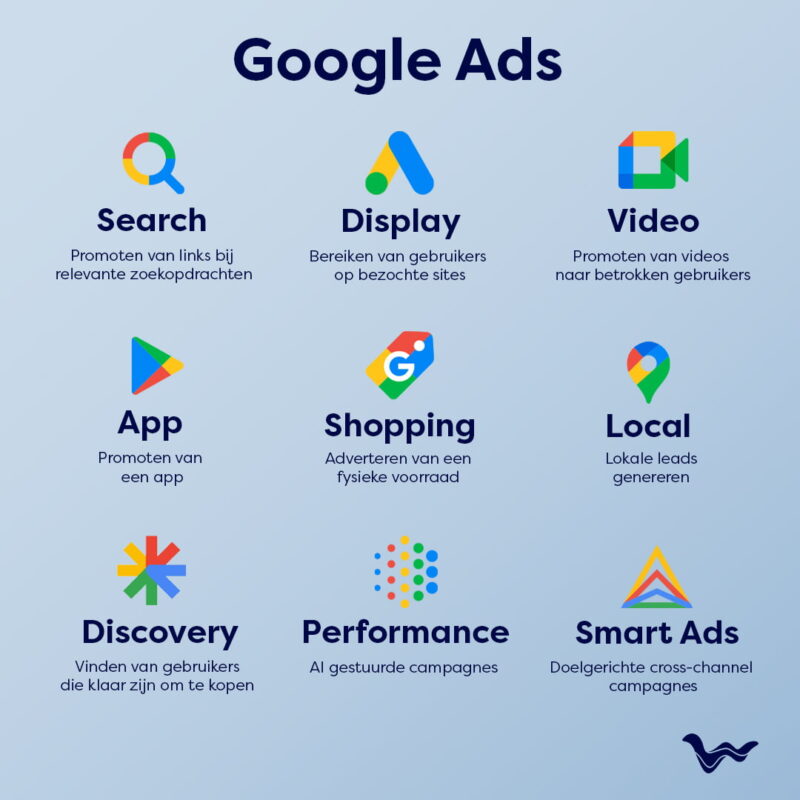
Within Google Ads, there are nine different types of ads to choose from, namely Search, Display, Video, App, Shopping, Discovery, Local Services, Performance Max and Smart Ads.

Each type of Google Ad is displayed on one or more Google properties, including channels such as YouTube, Google Shopping, the Google SERP, Gmail inboxes and the Play Store. Most types also have options to appear on properties of external partners on the Web.

2. Google Display

What are Google Display ads?

Display ads show users visual ads across multiple devices and locations they are displayed on Google’s extensive Display network, which includes tens of millions of apps and websites. These can appear as the top of a page as banner ads, stacked on the side or throughout it a web page, app or interface.

Good to know about Display ads

Google selects which ads to show based on the subject of the Web page, the user’s browsing history and how the user’s activities fit with market categories chosen by the advertiser.

Since Display ads appear amidst the content users are trying to view (and are sometimes perceived as distracting), the click rate can be low but the conversion rate high. But it is important not to focus only on clicks. Google Display acts as digital billboards, so to speak, that follow users on their virtual journeys. These ads increase brand awareness even if they do not generate clicks.

Google Display in brief

Key features

  • Visually oriented
  • Covers more than 35 million apps and websites, as well as Google properties.
  • Tracks users on various advertising platforms based on their behavior.

Optimal for
Increasing awareness in new markets, repeating your message and retargeting warm visitors.

Placement
On millions of web pages, apps and Google properties in the Display network

Key KPIs
Views, Clicks, CTR

3. Google video

What are Google video ads?

As the name suggests, this is purely about video ads. These ads are hosted on YouTube and also primarily shown to users there. They come in six varieties:

  1. Skippable In-Stream Ads: These appear before, during or after videos and have no maximum length. They play until completed or the user skips them.
  2. Non-skippable In-Stream Ads: Up to 20 seconds long, these in-stream ads play without the option to skip.
  3. In-Feed Ads: For advertisers who want to promote a video on the YouTube homepage, among organic search results or in the video feed under active YouTube videos.
  4. Bumper Ads: Similar to non-skippable in-stream ads, bumper ads last only six seconds and play at the beginning of a video.
  5. Outstream Ads: Like Display ads, outstream ads are promoted videos played only on Google Video Partners’ network, with no maximum length.
  6. Masthead Ads: The top tier of video ads, these are played at the top of YouTube’s homepage.

Good to know about Video ads

In Google Video campaigns, you can choose your placements in several ways. You have the option to show your video before videos that deal with specific topics, you can select specific channels or creators, or you can target people who have shown certain search behavior or interest.

Similar to Google’s text-based ads, Video ads can also be displayed on sites outside of Google through the video partner network. These apps, games and websites went through a thorough screening process, including assessments of video quality, available ad management platforms and revenue models.

Google Video ads in brief

Key features

  • Can be used to promote products via video or to promote existing videos.
  • Available in multiple formats that play before, during and after YouTube videos.
  • Can also be displayed on external apps, games and websites.

Optimal for
Promoting your videos or reaching highly engaged users with dynamic video ads.

Placement
Before, during and after videos on YouTube; in YouTube’s search feeds; on YouTube’s home page; and across the Google Video Partners network.

Key KPIs
Views, Video views, View rate, Clicks.

4. Google App

What are Google App ads?

If you’re promoting an app, these ads work in a similar way to Shopping ads. Instead of having to create entire ads yourself, all you have to do is enter simple text, indicate your language preferences and set a budget. Google then uses information from your app listing in the Play Store to automatically test different layout combinations and display the most relevant ones for keywords.

These app ads can appear in various places, including Google SERPs, Google Discover, Play Store search results, Play Store-related and featured app sections, YouTube feeds and the search partners network.

Good to know about App ads

Google App ads are focused on conversions, namely: app installs, app engagement and app pre-registration. So setting up conversions is a must to run an App campaign. For the Google Play Store, this is easily done within a few clicks. For your iOs app, you will have to get your conversions from Google Firebase.

Google App ads in brief

Key features

  • Can be used to target new users and current users.
  • Displayed on a wide range of ad surfaces.
  • Campaigns focus on installations, engagement or pre-registration.

Optimal for
Promoting an existing app or an upcoming app.

Placement
Play Store search results, Play Store suggestions, Google SERP, YouTube feeds, Google Discover, and about the Google search partner network.

Key KPIs
CTR, Conversion rate.

4. Google Shopping

What are Google Shopping ads?

Unlike Search ads, which require advertisers to create their own texts, Shopping ads pull data from product feeds in the Google Merchant Center. Sellers with physical inventory can use these automatically generated ads to sell products on:

  1. Google SERP: Shopping ads populate the SERP with relevant keywords and may appear while scrolling or as a set of images along the right margin of the page, linking to the Google Shopping page.
  2. Google Shopping: Sponsored Shopping ads appear in a carousel at the top of the page for extra visibility.
  3. Google Images: Carousels of Shopping ads appear at the top of results for image searches related to products.
  4. Google Maps: Local inventory ads appear at the top of listings for relevant keywords in Google Maps searches.
  5. Search partner websites: Shopping ads appear in search results and directories on various search partner websites, which are not specifically mentioned by Google.

Good to know about Shopping ads

Because Shopping ads are built from actual product data in the Merchant Center, they contain a quick summary of basic information rather than creative text. Each ad displays elements such as price, sales notifications, price cuts, user reviews, brand name and product name.

Google Shopping ads in brief

Key features

  • Contains product images.
  • Completed automatically using data from the Merchant Center.
  • Appears on Google properties and search partner search results.

Optimal for
Selling physical products listed in the Google Merchant Center.

Placement
All over Google Shopping, SERP, Images, Maps and search results from search partners.

Key KPIs
CPC, CTR, Conversion rate, ROI.

6. Google Local Services

What are Google Local Services ads?

Local Services Ads are not technically part of the core of Google Ads, but it is still a type of Google ad. Advertisers with local products and services can create these campaigns within the Local Services Ads hub.

When people click on those ads, they can directly call the company or send a message. As a result, advertisers get very specific leads from people who are ready to buy something. It is also good for users because lower response rates and poor reviews can hurt ads. So, it is advantageous that the best companies appear first.

Good to know about Local Services ads

To advertise through Local Services, you must meet Google’s licensing, insurance and background check requirements. For this, Google has four Google badge statuses: Google Screened, Google Guarenteed, License Verified by Google and Pre-Badge.

Google Local Services in a nutshell

Key features

  • Connects directly with customers through the advertising platform.
  • Appears in local searches.
  • Highly targeted, local lead qualification.

Optimal for
Advertising geographically specific products or services for local leads.

Placement
Google SERP and Google Maps.

Key KPIs
Number of leads, CPL (cost-per-lead), ROAS (return-on-ad-spend).

7. Google Discovery

What are Google Discovery ads?

Discovery Ads make smart use of scalable machine learning that focuses on intentions. By combining customer intent signals, artificial intelligence and your preset bids and conversion goals, Google Discovery Ads automatically adapts to the needs of end users.

Good to know about Discovery ads

As an advertiser, add multiple images, headlines, descriptive text, a logo and a company name. Google uses these elements to display the ad in various places, such as Discover feeds, the YouTube home page and the Watch Next feed, as well as Gmail’s Promotion and Social tabs. Because users are already browsing these spaces, Discovery Ads have higher conversion potential because they are naturally closer to the purchase decision stage.

Google Discovery ads in brief

Key features

  • Uses artificial intelligence and machine learning to automatically adjust ads on different surfaces.
  • Appears on Discover, YouTube and Gmail.
  • Includes multiple images.

Optimal for
Advertising geographically specific products or services for local leads.

Placement
Targeting users ready to make purchases with visually oriented automated ads.

Key KPIs
Views, Clicks, CTR.

8. Google Performance Max

What are Google Performance max ads?

Google Performance Max automates ad campaigns across all Google Ads channels by combining advertiser goals and material with Google’s AI and machine learning for optimized ads on each channel. No choice of ad type needed; just give all the elements to Google, and it handles the rest with machine learning for maximum visibility with qualified users.

Good to know about Performance Max ads

Performance Max campaigns are driven by specified conversion goals.

Performance Max works like a “black box. Although you get results for high-performing audiences, it lacks complete data for accurate optimization. This leaves you without insight into channel-specific performance and asset utilization, which makes it difficult to make effective changes to your campaigns or assess the performance of each channel.

Google Performance Max in a nutshell

Key features

  • Uses machine learning and AI to automatically optimize ads.
  • Automatically displays ads on all Google ad channels.
  • Can identify new market segments based on goals and real user behavior.

Optimal for
Automatic creation of ads optimized for audiences on all Google channels.

Placement
All Google advertising channels.

Key KPIs
Conversions, Conversion rate.

9. Google Smart Ads

What are Google Smart ads?

Smart Ads are similar to Performance Max, but slightly simpler. Instead of aggregating all the elements of an ad campaign and automatically generating finished ads, Smart Ads require just a bit more active engagement. However, they still offer convenient automation features and placement across multiple channels.

Smart Ads campaigns serve as central hubs, allowing advertisers to achieve specific goals, such as increasing video views, generating website traffic and growing local leads. All this without having to create separate campaigns for each channel.

Good to know about Google’s smart ads

With Smart campaigns, Google manages who sees your ad, when and where, as well as how your ad budget is spent. As a result, you have less control yourself. Smart campaigns are therefore especially ideal for small business owners. It lets you create powerful ad campaigns in less time, so you can stay focused on the day-to-day tasks of running a business.

Google Smart ads in brief

Key features

  • Function as centralized hubs for cross-channel advertising.
  • Prioritize campaign-level goals over ad-specific channels.
  • Focus on themes of keywords rather than specific keywords.

Optimal for
Automatic creation of ads optimized for audiences on all Google channels.

Placement
Execute targeted campaigns that prioritize results over ad channels.

Key KPIs
Conversions, Conversion rate.

Need help setting up your Google Ads?

Boost your brand with powerful Google ads managed by Wildeman Creative Agency. We offer expert guidance and strategies to improve your online presence. Contact us for more information!

Contact us

Why use a social media calendar?

By Marketing & Communication

In the world of online marketing, it’s all about timing. The right message, at the right time, can make the difference between going unnoticed and going viral. But how can you make sure you always strike at the right time? The answer: a social media calendar. 🗓️

What is a social media calendar?

A social media calendar, also known as a content calendar, or marketing calendar, is a tool that helps marketers keep track of important dates and events. It includes an overview of national and international holidays, events, seasonal trends, and industry-specific milestones. By collecting and organizing this information, marketers can anticipate opportunities and plan strategies to reach their target audience at the right time with relevant content. 🌐

The benefits of a social media calendar

Popular Content 🐝

A social media calendar helps you take advantage of popular and viral content. That’s because you are hitching a ride on the buzz created on the day by dozens, hundreds or even thousands of other organizations.

Consistency 📅

A social media calendar promotes consistency in your marketing strategy. It helps you maintain a regular flow of content, which is essential for building brand awareness and engagement.

Save time 🕒

Planning your social media posts, content and online marketing campaigns based on a social media calendar saves a lot of time and stress. You don’t have to improvise at the last minute; you can determine your approach months in advance. 🕒

More interaction 💬

A social media calendar gives you the opportunity to create content that responds to the emotions, interests and current topics your target audience interacts with. As a result, there is often more interaction with the content.

Measurable 📈

A social media calendar allows you to measure and adjust the results of your marketing efforts. You can analyze which hook-up moments were most effective and which performed less well.

The risks of a social media calendar

Rigidity 🚫

The danger of a social media calendar is that you can be too focused on the schedule you have already made. It is important to remain flexible and respond to unexpected events or opportunities. If you stick too strictly to your calendar, you risk missing opportunities or appearing irrelevant when unexpected events occur.

Abundance of content ⚠️

Catching on too much can also work against you. If you always try to connect with current events, you run the risk of bogging down your message in the flood of information. It is important to be selective and only pick up on events that are truly relevant to your brand and target audience.

Misinformation 😒

There are lots of social media moments to choose from. Some hook-up moments are just a little more famous than others. So it is very important to do good research on the background of the event, holiday, special day, milestone or occasion. After all, you don’t want to make the wrong association or give the wrong information. This not only comes at the expense of your trustworthiness, but can also provoke negative reactions.

Examples of brands using social media calendars

There are many great hook-up examples of brands using a social media calendar the right way. Therefore, we highlight some great catch-up examples. ☀️Take advantage of them and get inspired!

Hema

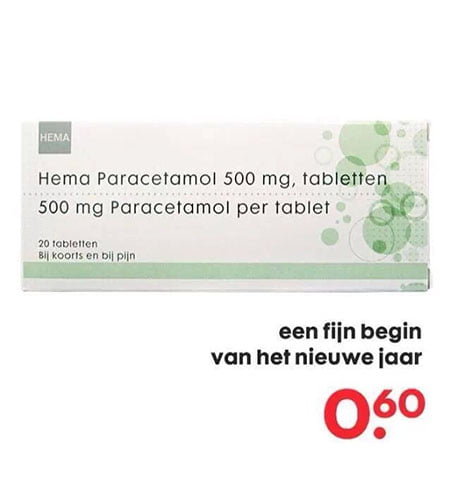
Hema played very nicely on New Year’s Day by making a post about paracetamol. Of course, they weren’t necessarily concerned with selling more paracetamol, but you do draw immediate attention in a fun and recognizable way that gives people a positive association with your brand.

Oreo

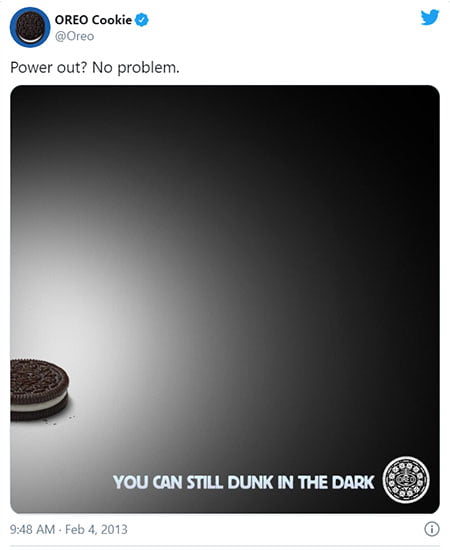
Oreo has a history of clever hook-up campaigns, such as their famous “You can still dunk in the dark” tweet during a power outage during the Super Bowl. This tweet went viral and became a classic example of real-time marketing.

WWF

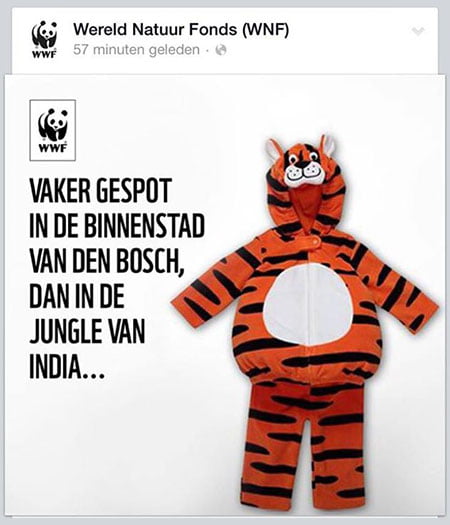
Hook-up moments can also be used very well by nonprofit organizations or to create awareness around social issues. WWF, then known as WWF, gave a good example of this during Carnival.

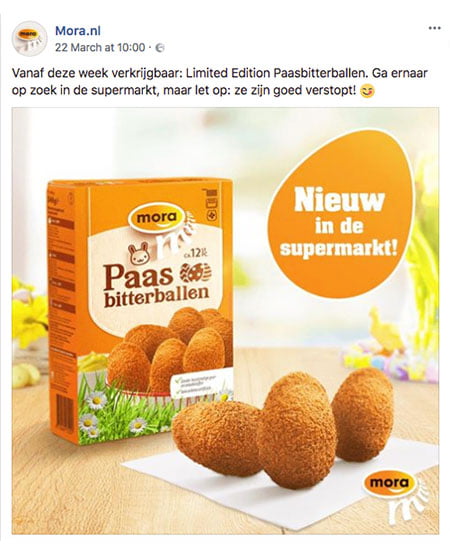
Mora

Mora responded very well to 2 pent-up moments at the same time, namely when Easter and April 1 fell on the same day. They knew how to attract attention in the right way by making a joke. This ultimately strengthened their brand image.

Tips for your social media calendar

Wondering which hook-up moments are a good fit for your organization? Look up existing social media calendars and write down for yourself which moments are relevant to your industry, organization and target group. Also look at what your competitors are doing and try to remain original. Think about what you can add to your catch-up calendar to reflect what kind of organization you are, what you stand for and what your core values are. For example:

Seasonal promotions 🌞

Plan special offers and content around different seasons, vacations and holidays. For example, if you own a clothing store, you can capitalize on the start of the summer season with summer discounts and style tips.

Branding milestones 🎉

Mark important dates in your company’s history, such as anniversaries or product launches. This can be an opportunity to share your brand story and engage customers in your journey.

Trending topics

Stay on top of current trends and events relevant to your industry. For example, if you are in the tech industry, you can catch up on the launch of new gadgets or software updates.

Content series 📝

Create content series that run throughout the year, for example, “Tip Tuesday” or “Throwback Thursday. This gives you a regular stream of content to keep your audience interested.

Research #hashtags #️⃣

Connect with popular hashtags on social media to increase your reach. If there is a trending hashtag relevant to your brand, use it in your calendar to get more visibility.

Conclusion

Conclusion: a social media calendar is an indispensable tool for effective marketing. 🌟 A well-planned social media calendar can not only improve your marketing results, but also increase engagement with your target audience and strengthen your brand. It is a powerful tool that helps you deliver your message at the right time and in the right way. It allows you to communicate with your target audience in a timely, relevant and consistent manner. Most importantly, however, stay flexible and seize opportunities as they arise. Also, be critical about what catches up suits your organization. After all, it makes no sense to capitalize on moments that are not relevant to your target audience or organization. That can actually be detrimental and is often a waste of your time since there will most likely be little interaction with it.

Need help strategically planning your content?

Sander has 25 years of experience in conceiving and executing branding & marketing campaigns, with content planning being an essential part of it. Are you looking for support and want to know how he can help you? Then get in touch.

Get in touch

Cialdini’s 7 principles of influence – Explanations and examples

By Marketing & Communication

The psychology of persuasion is an intriguing field in which researchers and marketers have long sought to understand how people make decisions and why they are influenced. One of the most influential figures in this field is Robert Cialdini, an American psychologist whose work has guided communications and marketing professionals since the 1980s. His theories are known as the “Cialdini principles” and have led to a deeper understanding of how people are influenced and how these principles can be applied to guide (buying) behavior. 🛍️

What is Cialdini's success?

Robert Cialdini’s success lies in his ability to translate complex psychological principles into practical applications in marketing, sales, and communications. His work has enabled marketers and professionals to better understand and influence human behavior, leading to significantly improved results in terms of conversions, sales, and customer relationships. Cialdini’s principles have gained worldwide recognition and are considered valuable tools in the field of persuasion psychology.

From six to seven Cialdini principles

To avoid confusion, it is good to know that it was first six cialdini principles. A seventh cialdini principle has recently been added: unity. And this is not just any principle, it is a principle that is incredibly important for the times we live in today and that we are going to have to deal with more and more. We explain all the Cialdini principles below. 👇

What are Cialdini's 7 principles?

Let’s start right away with an overview of Cialdini’s 7 principles of influence. Because what exactly are the 7 Cialdini principles and how do you apply them in practice? In this article we list all the Cialdini principles, including practical examples of how to apply them within marketing, sales and communications. All of Cialdini’s principles at a glance:

  1. Reciprocity
  2. Scarcity
  3. Authority
  4. Consistency
  5. Sympathy
  6. Social proof
  7. Unity

1. Reciprocity 🎁

What is the Cialdini principle of reciprocity

The Cialdini principle of reciprocity is based on the idea that people tend to do something in return when someone does something for them. The feeling of obligation arises when someone receives a favor and motivates them to do something similar in return.

How do you apply reciprocity in practice?

Make someone feel like they want to give something back. To do that, it’s important that you give them something first. So offer value to potential customers before asking for anything, such as a free trial or exclusive offers. Or, for example, give free samples or extras with purchases to encourage reciprocity.

Examples of Cialdini's reciprocity:

2. Scarcity ⚖️

What is the Cialdini principle of scarcity?

The Cialdini principle of scarcity is based on the idea that people are sensitive to a shortage of something. When something is presented as limited or rare, its value increases in our perception. This principle is often used in marketing to increase urgency and encourage people to take action quickly.

How do you apply scarcity in practice?

Want to influence your target audience by applying scarcity? Then emphasize the limited availability of a product or service to increase demand. For example, use time-limited offers to emphasize urgency or actually make availability limited. Make exclusivity evident.

Examples of Cialdini's scarcity:

3. Authority 🎓

What is the Cialdini principle of authority?

The Cialdini principle of authority is based on the idea that people are more likely to obey individuals who are considered authoritative and knowledgeable. Using authority figures in marketing is an effective way to build credibility.

How do you apply authority in practice?

You apply this by showing evidence that you are an expert within your industry. Display certificates, awards, or reviews to highlight your expertise and authority in a particular field. Also, use other experts or authority figures to promote your products or services.

Examples of Cialdini's authority:

4. Consistency 🔄

What is the Cialdini principle of consistency?

The Cialdini principle of consistency is based on the idea that people strive for consistency in their own behavior and beliefs. Once they have made a certain choice, they tend to stick with that choice and adjust their behavior accordingly.

How do you apply consistency in practice?

You apply consistency in your influencing technique by encouraging potential customers to make small commitments that align with eventual desired actions. This way, someone gets further and further along in the buying process without them consciously realizing it. This is because people (unconsciously) feel that whoever says a must also say b.

Examples of Cialdini's consistency:

5. Sympathy 🫶

What is the Cialdini principle of sympathy?

The Cialdini principle of sympathy is based on the idea that people are more likely to do something for people they like. Creating sympathy is a powerful way to influence the behavior of others.

How do you apply sympathy in practice?

You apply sympathy in Cialdini’s influence principles by creating a personal connection with potential customers. You do this, for example, by giving compliments or sharing common interests. For example, make sure customer service representatives are always friendly and helpful.

Examples of Cialdini's sympathy:

6. Social proof 🗣

What is the Cialdini principle of social proof?

The Cialdini principle of social proof is based on the idea that people often look to others to determine how to behave. Showing evidence that others exhibit a certain behavior can in turn convince others to do the same.

How do you apply social proof in practice?

Social proof is one of Cialdini’s most widely used influence techniques. You apply this by showing, for example: testimonials, reviews, number of customers who have already benefited from your product or service. Use social media to show that other people value and use your products or services.

Examples of Cialdini's social proof:

7. Unity 🙏

What is the Cialdini principle of unity?

The Cialdini principle of unity is based on the idea that people tend to identify (and feel connected) with others who share similar characteristics, beliefs or goals. This principle was later added to the original 6 Cialdini principles and emphasizes the importance of shared identity. Something incredibly important in the times we live in today. Consider, for example, the influence of influencers.

How do you apply unity in practice?

You apply Cialdini’s unity principle by identifying and expressing shared characteristics, beliefs or goals with your target audience. In doing so, you create a sense of unity and connection. Your target audience must recognize themselves in you as a brand and in the rest of the audience to feel they can rely on you.

Examples of Cialdini's unit:

Criticism of the Cialdini principles

While the Cialdini principles can be extremely effective in influencing consumer behavior, there are also legitimate concerns about ethics and manipulation. It is essential to apply these principles responsibly and ethically to avoid damage to the reputation of a brand or organization. The goal should always be to provide value to customers and build relationships based on trust.

Conclusion

In conclusion, the seven Cialdini principles have changed the way we think about persuasion and marketing. Understanding and applying these principles can lead to more effective communication, higher conversion rates and greater success in marketing, communication and sales. However, it is critical to use these principles with care and ethics so that they have a positive and lasting impact on customers and society as a whole. 🌍

Need help deepening your marketing?

Sander has 25 years of experience devising and executing branding & marketing campaigns that have included the use of Cialdini principles. Are you looking for support and want to know how he can help you? Then get in touch.

Get in touch

Color psychology in marketing: The importance of colors in brand identity

By Marketing & Communication

Color psychology is a fascinating subject that focuses on the influence of colors on human emotions and behavior 🌈. In the world of marketing and branding, understanding and applying color psychology is essential to effectively reach your target audience. Discover the power of color psychology and make your brand stand out. In this article you will read about the influence of color psychology on online marketing, how colors influence emotions and behavior, and how to apply it to your brand.

What is color psychology?

Before we explain the meaning behind colors, it is important to understand what color psychology is. Color psychology is the science behind the influence of colors on human behavior and emotions. The goal of color psychology is to understand why and how different colors influence our feelings, actions and decisions. This is because our brain 🧠 gives (unconsciously) a reaction when seeing a certain color. Understanding the psychology behind this will help you choose the right colors for what you want to achieve 🎯.

Examples of color psychology

  • Perfume: Luxury perfume brands often use gold and silver in their packaging to create a sense of elegance and exclusivity.
  • Soft drink: Many soft drink brands, such as Coca-Cola, use red in their branding to associate excitement and fun with their products.
  • Children’s products: Children’s products, such as toys and baby clothes, often use soft pastel colors to create a child-friendly look.

Do colors have a meaning?

To directly answer the question of whether colors have meaning: yes, colors absolutely have meaning and can have a profound effect on brand perception and consumer behavior 🙌. Understanding these meanings is invaluable for companies. The right color palette can give a brand a competitive edge. By researching your target audience, brand identity, competition and the meaning behind the colors, you can use colors to achieve goals.

The influence of color psychology on online marketing

Color psychology plays an essential role within online marketing because of the impact colors have on the target audience’s perceptions, emotions and actions. By understanding the meaning behind colors, you can apply the right colors at the right time and in the right way to most effectively reach your target audience and build your own brand identity. Wondering how color affects online marketing? 🔎 We list the benefits:

Emotion Generation

Colors have the power to evoke emotions. By choosing the right colors, you can stimulate desired emotions in your target audience. For example, using warm colors such as red and yellow can evoke excitement and enthusiasm, while cool colors such as blue and green convey confidence and calm.

Brand recognition

Consistent use of specific colors in your online and offline expressions, such as your website, logo and social media images, contributes to brand recognition. This means that when people see those colors, they immediately think of your brand.

Call-to-action (CTA).

Colors can improve the effectiveness of your call-to-action buttons. Using a striking color for your CTA, such as orange or red, can increase conversion rates because it grabs the user’s attention and prompts them to take action.

Psychological associations

Colors often have culturally specific meanings and associations. By leveraging this knowledge, you can reinforce your marketing message. For example, using greenery in a health and wellness context can reinforce associations with nature and health.

Targeted design

Color psychology helps marketers and designers tailor their design choices to specific audiences. For example, if you know your target audience is primarily young, energetic people, you can use colors that fit their lifestyle and preferences.

Visual hierarchy

By using colors intelligently, you can direct the attention of your target audience. Important information can be highlighted with bold colors, while less important elements are displayed in more subtle colors.

A/B testing and optimizations

Colors can be an important part of A/B testing and optimization efforts. By testing different color variations, you can discover which colors work best to achieve your goals, such as increasing click-through rates or conversion rates.

Unique brand identity

Using color psychology can help you create a unique brand identity that stands out from competitors. A carefully chosen color palette not only makes your brand recognizable, but also original and unique.

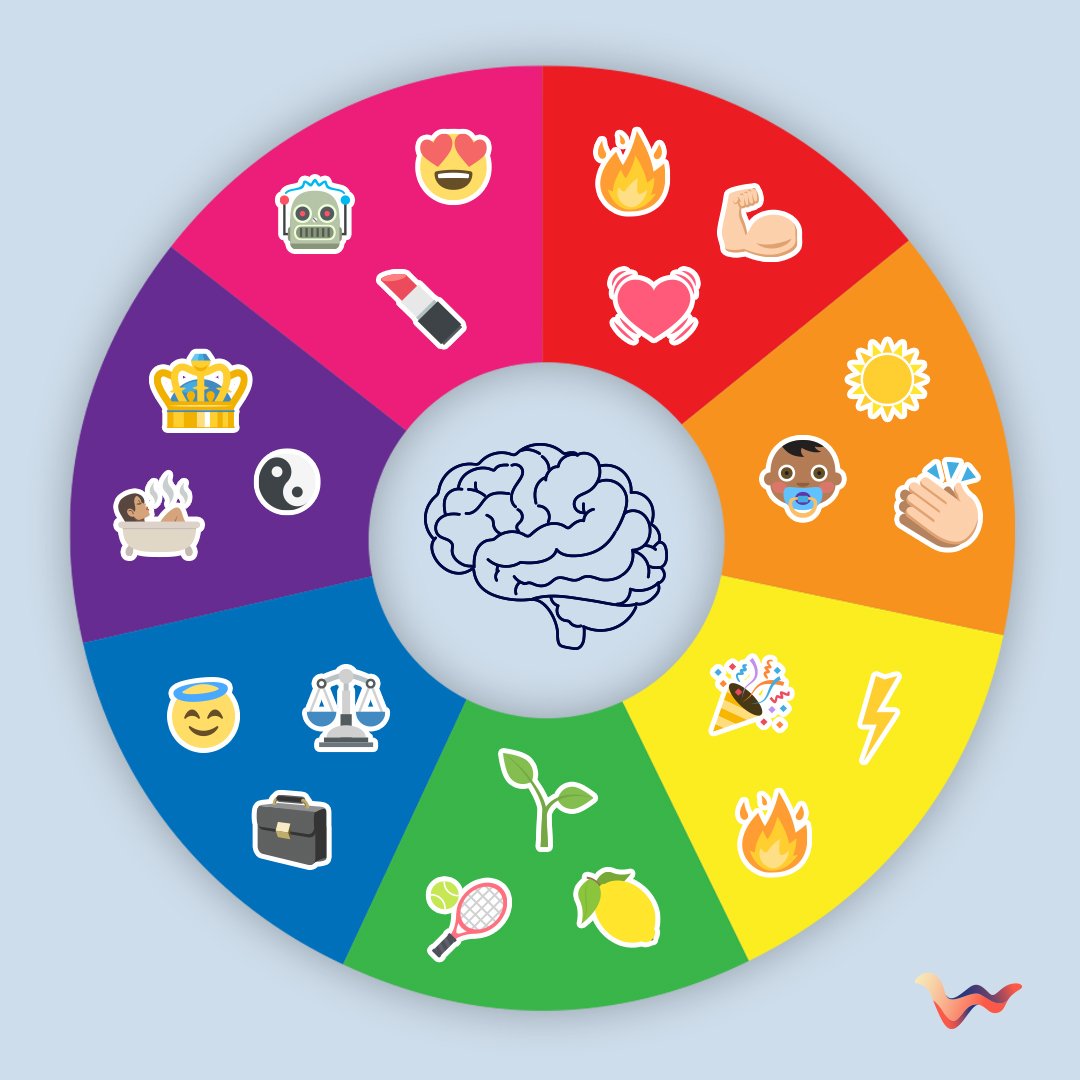
What colors give what feeling?

So different colors evoke different emotions and associations. But which colors evoke which feelings? 🧐 We share below an overview of the psychology behind different colors. Please note that this is generally true. However, it always depends on several factors such as your target audience, what you want to portray yourself, the competition and what the data says. So we always recommend testing the colors through a/b testing and extensive research.

Conclusion

Color psychology is a powerful tool in the world of marketing and branding. Understanding the emotions and reactions that different colors evoke can give your brand a competitive advantage. 🏆 Remember, though, that context is very important. Look carefully at your values, what you want to convey and what is important to your target audience. Then keep on testing, researching and optimizing. What do you want your brand to convey?

Need help professionalizing your marketing?

Sander has 25 years of experience conceiving and executing branding & marketing campaigns, including the application of color psychology. Are you looking for support and want to know how he can help you? Then get in touch.

Get in touch

The See Think Do Care Model: what can you do with it?

By Marketing & Communication

Are you using Google’s See Think Do Care Model? In the rapidly evolving world of digital marketing, it’s all about understanding your target audience, and providing them with valuable information at the right time. If you are looking for a service or product, you want to be presented with the right information at the right time, right? ✅ You probably recognize the following example of how not to do it: you have just bought something at a web shop, and then you are shown irritating banners of the product for weeks on end. This is not only irritating for the person who sees them, but also a waste of the marketing budget. ❌

Spoiler alert: we can also tell you in advance that showing conversion-oriented ads asking someone to buy something won’t work with people who don’t know your business yet or aren’t interested in it at all. But what is the right time, and what kind of information should you offer at what time? Not to mention, of course, on what platform should you display that information? This is where Google’s See Think Do Care Model comes in.

What is the See Think Do Care Model?

With the See Think Do Care Model you map out the customer journey 🗺️ and create a funnel 🔻 in which you guide a potential customer or lead from A to Z as efficiently as possible. From becoming aware that your brand, company, service or product exists, to converting an interested party into a customer, and even the step after that: retaining a customer and creating a positive brand image. ⭐

The four phases of the STDC Model

The See Think Do Care Model consists of four phases, as the name implies: See, Think, Do and Care. The phases address the needs of a potential customer or lead at a particular point in the customer journey (customer journey). The idea is that all the phases fit together so you create a funnel where you create a plan, detailing what content you show at what stage, to whom, when and on what platform. You basically work from a cold audience 🥶 to a warm audience 🔥. Retargeting is therefore an important part of Google’s STDC Model. Through different touchpoints you reach a person multiple times, and pull someone through the funnel, so to speak.

How do you deploy the STDC Model?

By using the See Think Do Care model, you can take your online marketing strategy to the next level, and get the best results within the available budget. But how do you use the See Think Do Care Model and what exactly do the four phases entail? We explain it below ⬇️.

SEE phase: Awareness 👁️

In the See phase is your target audience who do not yet know your brand, company, product or service and do not yet have a specific need or clear interest. They are coming in contact with your company for the first time. The objective in this phase is to capture their attention and spark their interest. You want to let them know you are there and what you have to offer, without trying to sell directly. The goal of the See phase is to create brand awareness and name recognition. So make sure you reach as many people in your target audience as possible during this phase. Once you have captured their interest, you can gradually lead them through the next stage of the buying process.

THINK phase: Consideration 🤔

In the Think phase, potential customers are aware of what you have to offer and have already shown interest. Think by interacting with your ads (from the See phase), interacting on social media, visiting your website, etcetera. However, they are still researching at this point, and want to get as much information as possible before deciding whether to move to the next phase. This is the time to offer valuable, informative content that will help them make their decision. Consider blog posts, informative videos, social media posts and ads, comparison guides, white papers, user-generated content, reviews and customer case studies. Make sure you are visible in a positive way so you are top of mind once they move to the next stage, taking an action.

DO phase: Action 🛍️

In the Do phase, your potential customers are ready to convert. They’ve done research, and are now choosing which company to take action at. This is where you focus on conversion-oriented content, such as offers, discount codes and clear calls to action that win them over. Why should they choose you and not the competitor? Incorporate this into your content with a clear call to action: what do you want them to do after seeing the content/advertisement? Use the warmest target group in this phase: the target group that has already seen your company several times, has shown interaction with the ads (See- and Think phase), has visited the website, and of whom you are sure they have picked up enough information and are ready to convert.

CARE phase: building customer relationships 💖

After the purchase, the Care phase begins. This is the phase where you strengthen customer relationships. Think about having excellent customer service, valuable support and personalized communications. The goal is to create loyal customers who are going to recommend your brand to others, make repeat purchases and leave positive reviews. Email marketing plays an important role in this. Just make sure you do this in a positive way so that it is not perceived as annoying. After all, no one wants to be spammed with irritating banners and emails every day for months after buying a product.

Conclusion

Google’s See Think Do Care model thus provides an effective strategy for engaging your target audience at all stages of the customer journey. By being aware of your target audience’s needs and interests at each stage, you can create effective content and offer it at the right time. This will increase your chances of conversions and build strong customer relationships. So, leave behind those “annoying banners” that push people to buy something, and embrace the potential of an online marketing strategy based on the See Think Do Care Model. 🌟

Need help professionalizing your marketing?

Sander has 25 years of experience conceiving and executing branding & marketing campaigns, including using the STDC model. Are you looking for support and want to know how he can help you? Then get in touch.

Get in touch
Blog Social Media Strategie

Setting up a successful social media strategy: here’s how to do it

By Marketing & Communication

Are you active on various social media platforms, but find that you are not achieving the success you want? ❌ Would you like to gain more followers on social media, better reach your target audience and create catchy social media content? ✅ Then a social media strategy is indispensable. It provides you with a clear roadmap to achieve your goals. In this article we share how to set up a successful social media strategy and provide valuable insights and practical tips to take your social media to the next level. This way, you reach your target group better, increase your company’s online visibility and get the most out of your social media channels.

What is a social media strategy?

A social media strategy ensures that you plan your approach and use social media channels in the right way and at the right time to achieve your goals. By working this out in a social media strategy, you get a good overview of all possibilities within the various social media platforms. You focus on the goal 🎯 and work through concrete steps 👣 towards the goal. You will think about various aspects within social media marketing such as objectives, target group analysis, platform selection, content strategy, interaction, analysis and optimization.

How does marketing
through social media work?

Marketing via social media involves promoting 📣 your products, services or brand on various social media platforms. The goal is to capture the attention of your target audience, build brand awareness, create engagement and ultimately generate conversions. Successful social media marketing requires a well thought out social media strategy, consistency, creativity and the ability to listen and respond to the needs of your target audience. It is important to experiment, learn from your results and continuously improve your approach to achieve your marketing goals.

What should be in a
social media strategy?

A good social media strategy includes several aspects, we explain them below:

  • Objectives
  • Target group analysis
  • Platform Choice
  • Content Strategy
  • Interaction and engagement
  • Analysis and optimization

Objectives

Formulate clear and measurable goals for your social media marketing 🏆. Consider increasing the number of followers, generating conversions, improving engagement with your target audience, building brand awareness, projecting a positive brand image and so on. In fact, the social media strategy you employ differs for each goal. A different approach is needed to generate conversions than to build brand awareness. Do you have multiple goals you want to achieve with social media? You can. Then create a separate strategy for each goal and see how you can best link the strategies together through a content strategy.

Target group analysis

Get to know your target audience well 🧐. Identify their needs, interests, pain points and communication preferences. Only when you know this can you set up the right social media strategy. After all, you want them to stop scrolling, interact with your post or ad, and do what the goal is. However, they will only do this if the content perfectly matches their needs. So, think about who your target audience is and how you capture their attention in a positive way.

Platform Choice

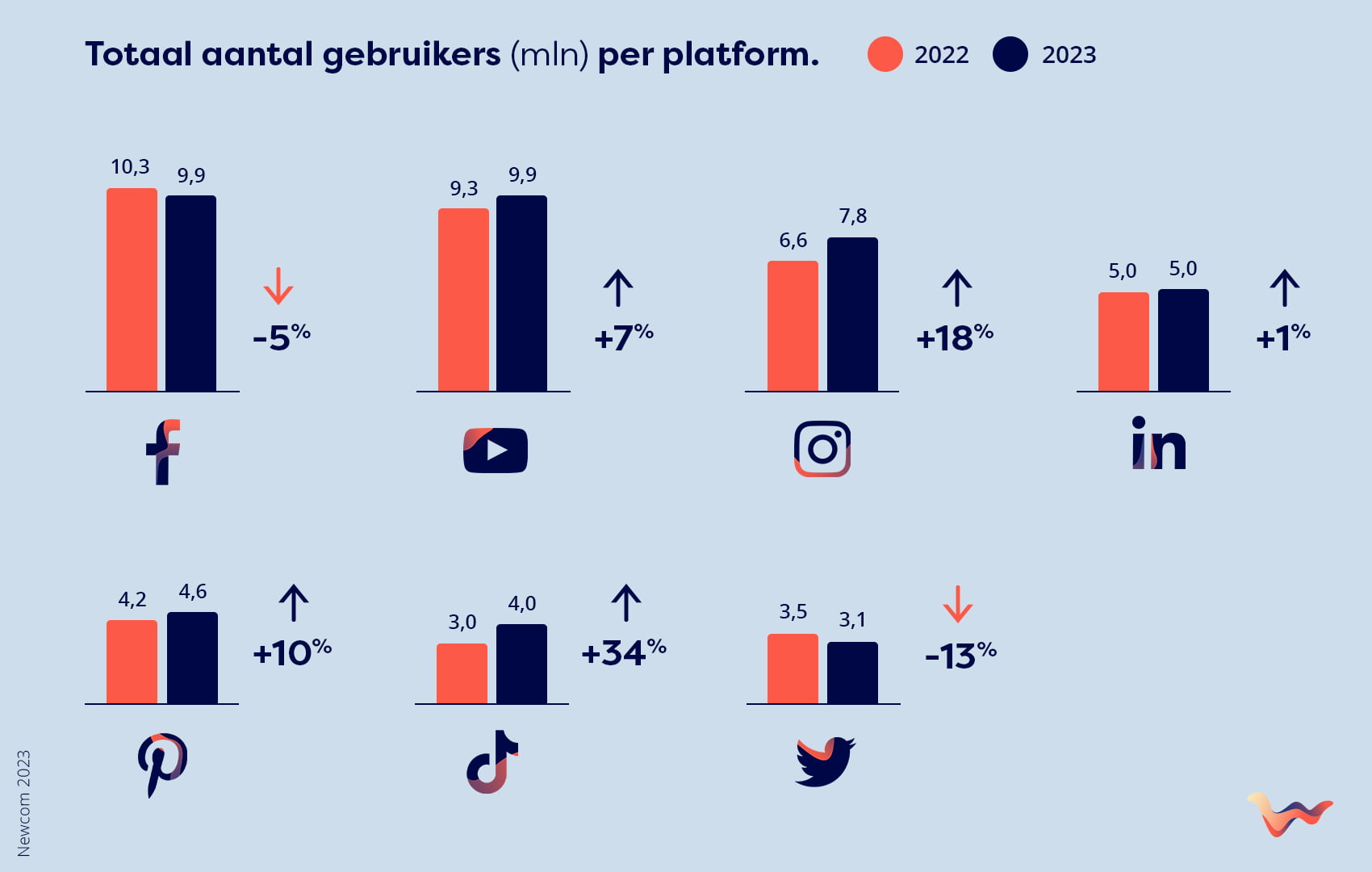
Determine which social media platforms best suit your target audience and your content. Focus on the platforms where your target audience is active. There are multiple social media platforms where your target audience may be, consider:

Content Strategy

Develop a strategy for creating and sharing relevant and valuable content 🖼️. Consider the format, tone of voice, branding, frequency, schedule and content of your posts. A good content strategy includes the following elements:

Form and content

Determine what type of content 📸 is most effective for your target audience. What do they respond well to and what grabs their attention? For example, consider sharing videos, infographics, case studies, blog articles, customer photos, reviews, a behind-the-scenes look, etc. What content you use depends on the goal you want to achieve. For example, if your goal is to demonstrate expertise, infographics and case studies are a logical choice. Do some research into whether your target audience actually wants them. Then analyze the data and test new forms of content.

Tone of voice and corporate identity

Tell a cohesive story that fits your brand and sets you apart from the competition. Your social media channels are like business cards in that respect 🪪. Make it clear who you are, what you do and why you do something. In addition, keep your branding consistent in all your content. That way you remain recognizable to your target audience and build brand awareness. Your target audience should be able to instantly recognize a post of yours by its style, colors and formatting. Otherwise, you’ll disappear among all the other messages they scroll past. What is your tone of voice and corporate identity?

Schedule and frequency

Create a content calendar 🗓️ and plan your posts ahead. This provides a clear overview and a concrete path toward your goal. You can immediately see what kind of content you currently have and what is still missing. Creating a content schedule also contributes to the consistency and variety of your content. Your followers will know what kind of posts to expect from you and won’t be surprised by surprises they might not be expecting. After all, they follow you because they like your brand and/or find your posts interesting. When doing this, also think about the days and times when your target audience is active. Do research on the ideal frequency and schedule.

Interaction and engagement

Interact with your followers 💬. Answer questions, respond to comments and create engagement by responding to relevant content from others. This is how you build an online presence and are more visible to your target audience. In addition, higher engagement with your posts ensures that your posts will be shown to more followers. This is because it depends on the algorithm of the social media platform. Posts with little interaction are often shown to fewer people than posts with a lot of interaction. Determine in your social media strategy exactly how you are going to do this. Before you know it, you’re several months down the road and you still haven’t made time to interact with your followers. Think carefully about your tone of voice. How exactly do you want to address your target audience?

Analysis and optimization

Monitor and regularly analyze the results 📊 of your social media marketing. Adjust your social media strategy based on the insights gained to get better results. You can always optimize the strategy. Keep constantly testing new forms of content, monitor the needs of the target audience, respond to trends, analyze competitors and look at statistics to see what works well and what doesn’t. Don’t be afraid to scrap and adjust things as long as you do it based on the wants and needs of your target audience and as a result of thorough research and data analysis.

How can you improve your social media
strategy?

Want to improve your social media strategy? You can take the following steps to take your social media marketing to the next level:

  • Promote your posts
  • Learn from your target audience
  • Learn from your competitors
  • Experiment with content
  • Define your added value
  • Engage in collaborations

Promote your posts

By advertising on social media, you can reach many more people with your posts. It is a shame if your timeline is full of beautiful and valuable content, but a small part of your target audience sees it. Boost your posts 🚀 and set up successful social media campaigns to reach your target audience very specifically. For each goal in your social media strategy, work out what kind of campaign you want to set up, how you will set up the targeting and on which channels you will promote the posts.

Learn from your target audience

In the end, it’s all about showing content that your target audience is actually waiting for. Therefore, analyze your target audience’s reactions and engagement among the posts you post. How many reactions 💬, likes ❤️ and shares 🙌 does a particular type of content have? What kind of reaction are there under your posts? Adjust your content and social strategy based on their preferences and needs. Not so sure what kind of content they want to see? Interact and ask them!

Learn from your competitors

You can learn a lot from your competitors. What kind of content are they posting? How many interactions do they have on their posts? What do their followers find interesting? Of course, you’re not supposed to copy their content directly, but you can get inspiration and put your own spin on it. So spend plenty of time analyzing social media strategy examples from competitors 🔍 and take advantage of them.

Experiment with content

Try out different forms of content, visuals and text. For example, do your followers respond better to videos, stills, animations or something completely different? Test what works best for your target audience 🧪. Also think about the topic of the post. What kind of content is best to use for this to best tell the story.

Define your added value

Make sure your content is valuable, relevant and appealing to your target audience. Offer solutions to their problems and inspire them 💡. Ask yourself, “What value does my social channel add to my followers?” Think for yourself why you follow certain accounts. This can give you a lot of interesting insights for your own social media strategy that you can then test with your target group.

Engage in collaborations

Enter into collaborations 🤝 with partners, customers and influencers, for example. You can very easily start a collaboration on almost all social channels. For example, organize a contest, win action, sponsorship, an account take over etc. Be creative! The advantage of a collaboration is that you reach many more people than just your own followers, because you also reach the followers of the collaboration partner.

Conclusion

An effective social media strategy and content strategy are essential to achieving success on social media. By understanding your target audience, creating valuable content, interacting, and constantly analyzing and optimizing, you can get the most out of your social media activities. Create a detailed social media plan and follow the steps to implement your strategy. To set up an effective social media strategy, follow these steps:

  • Define your goals, what exactly do you want to achieve?
  • Get to know the wants and needs of your target audience
  • Select the social media platforms that best match your target audience and content
  • Develop a content strategy, including the type of content, frequency and tone of voice.
  • Analyze your competitors’ social media accounts and posts
  • Think about the added value you offer with your own content
  • Plan your content through a content calendar
  • Interact with your followers and build an online presence
  • Reach more people within your target audience through ads
  • Engage in collaborations with partners, customers and influencers
  • Monitor and analyze the performance of your social media posts
  • Optimize your strategy based on the results
  • Keep experimenting with new forms of content

Need help professionalizing your marketing?

Sander has 25 years of experience devising and executing branding & marketing campaigns. Don’t have the time or the right knowledge in-house to create a successful social media strategy? Then get in touch.

Get in touch